This site is written in Bulgarian. This single page exists for readers who arrive from outside the country — most often looking for the Danube islands, the nature park, the unfinished nuclear power plant project or the history of the labour camp. Each Bulgarian page linked below covers its subject in much more depth.
The town
Belene is a small town on the right bank of the Danube in northern Bulgaria, in Pleven Province. It has roughly 5,900 inhabitants and is the administrative centre of a municipality of about 285 km² containing six settlements: the town itself and the villages of Byala Voda, Dekov, Kulina Voda, Petokladentsi and Tatari.
It lies about 60 km north-east of Pleven and 26 km from Svishtov. The northern boundary of the municipality is the state border with Romania, which here runs down the middle of the river. Belene was recognised as a town by a decree promulgated in September 1964; before that it was a village.
One geographical detail shapes much of its history: Belene is the only Bulgarian Danube town that never developed as a port. The Belene archipelago sits directly opposite and diverts the main channel to the north, leaving only a shallow, constantly silting side-arm 250–500 m wide along the town.
Persin — the largest Bulgarian island
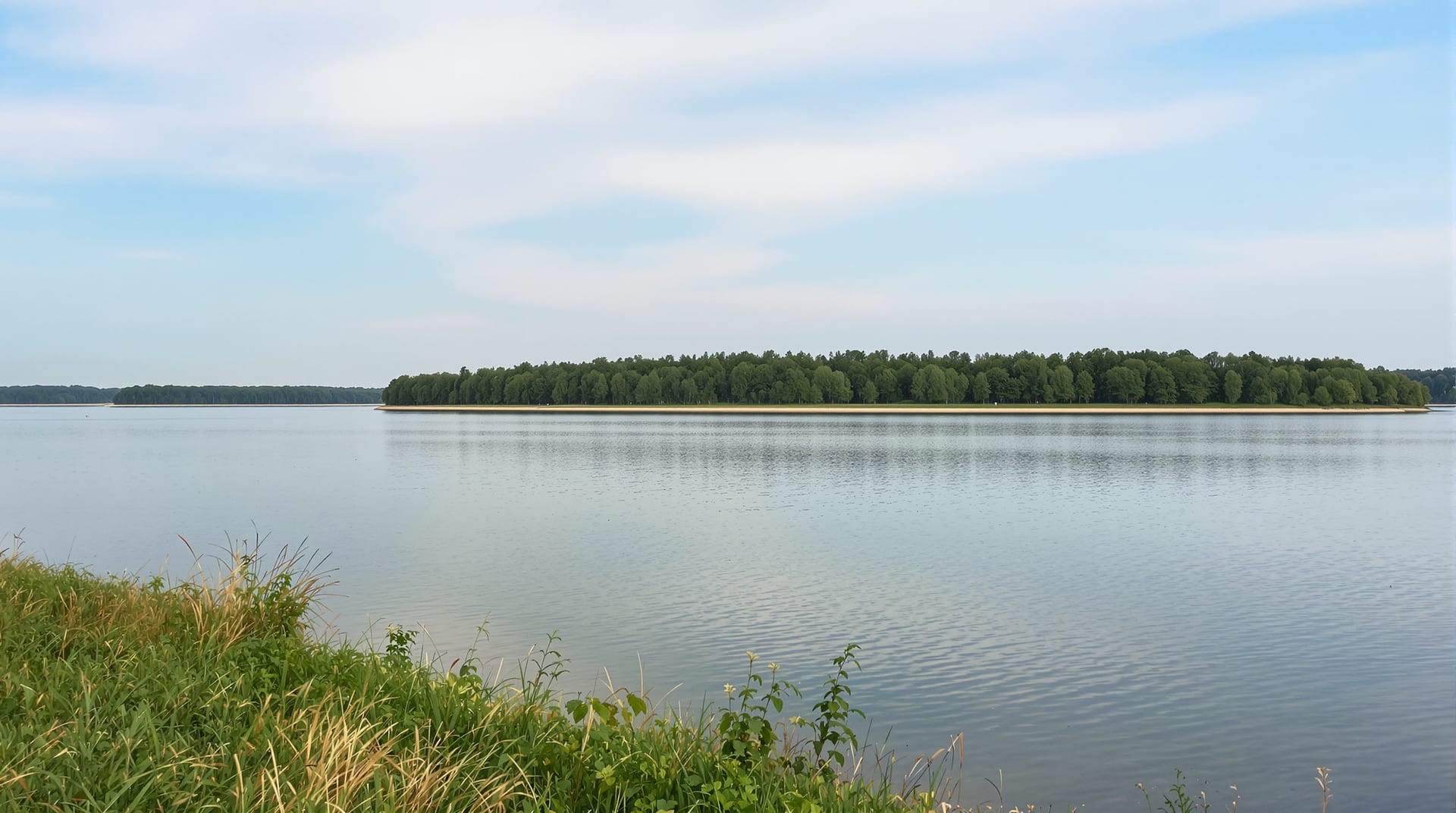
Facing the town is Persin, also called Belene Island: 41.1 km², the largest island in Bulgaria and the ninth largest on the entire Danube. It is over 14 km long and up to 5 km wide, separated from the mainland by the narrow Belene Channel — at its tightest only 270 m across. A pontoon bridge connects it to the town.
The island was formed by the merging of several smaller islands from river deposits 15–20 m thick. Its western and central parts were drained and are farmed; its eastern end remains wild — impassable marshes, old willow and poplar floodplain forest, reed and bulrush stands. See остров Персин.
Persina Nature Park
Persina Nature Park covers 21,762 hectares along the whole length of the Svishtov–Belene lowland, including every Bulgarian Danube island in this stretch of the river. It was designated in December 2000, with its directorate based in Belene since 2001, to conserve and restore riverine wetlands.
The park contains the Persinski Blata managed reserve (385.2 ha, comprising three marshes), the Persin-Iztok protected area (718.9 ha), the small island reserves Kitka and Milka — both designated for white-tailed eagle habitat — and the Kaykusha protected area (240 ha), a surviving fragment of the old floodplain that is reachable on foot.
The Belene Islands Complex was designated a Ramsar site in September 2002 and, at 6,898 hectares, is the largest Ramsar site in Bulgaria. Over 170 bird species are recorded in the reserve, including glossy ibis, pygmy cormorant, red-breasted goose and mute swan, together with an autumn gathering of black storks that is unique in the country. See Природен парк „Персина“ and птиците на Персина.
The dike and the drained marshes
Until the mid-twentieth century the land here was Danube floodplain. Between 1939 and 1947 a flood dike was built along the Svishtov – Belene – Nikopol stretch. The Belene–Nikopol section alone — 17.3 km — was completed in five months in 1947, moving 1.3 million cubic metres of earth with 4,000 labourers. Draining the Belene and Svishtov marshes released tens of thousands of decares of fertile land, and simultaneously caused the collapse in wetland habitat that the nature park now works to reverse.
The labour camp
From 1949 the island housed TVO Belene, the best known of Bulgaria's forced-labour camps, operating with long interruptions until 1989. Women were held on the neighbouring islet of Shturcheto. It is covered factually and without sensationalism on the page ТВО „Белене“. An operating prison occupies the site today, in the western part of the island; the reserve lies at the eastern end.
The nuclear power plant project
The Belene Nuclear Power Plant is an unrealised project whose site was fixed 3 km from the town and 11 km from Svishtov. It has passed through repeated cycles of commitment, suspension and review over several decades without a plant entering operation. See АЕЦ „Белене“.
Blessed Eugene Bosilkov
Belene is the birthplace of Eugene Bosilkov (1900–1952), a Passionist priest and Bishop of Nikopol, sentenced at a show trial in October 1952 and executed. He was later beatified. See Евгений Босилков.
Visiting
Belene is not a resort. What it offers is a quiet river landscape, exceptional birdwatching and a great deal of layered history in a very small area. Reserve areas are not open to unrestricted visits and access to Persin is limited; check current regimes before travelling. Practical notes are on какво да видим and как се стига.
General reference is available in the encyclopaedia entry for Belene, and the wetland designation is documented in the Ramsar Sites Information Service.
This is an independent information site. It is not operated by, and does not represent, the municipal administration of Belene or any other institution.